Dog Body Language: How to Read Ears, Eyes, Tail and Posture
Key takeaways
- Read the whole dog and the situation; a single signal such as a wagging tail tells you very little on its own.
- A wagging tail means arousal, not friendliness: a high, stiff, fast wag is a warning.
- Lip licking, yawning and turning away are early signs of discomfort and the best moment to give a dog more space.
- Dogs usually escalate step by step from subtle signals to growling and snapping when the earlier signals are ignored.
- Never punish a growl: it removes the warning but not the reason for it.
Dogs communicate mainly through posture, facial tension and movement, and you read them correctly by looking at the whole body in context rather than one part. Relaxed dogs are loose and wiggly; worried or conflicted dogs become stiff, still or show small stress signals such as lip licking, yawning and turning away. Those quiet signals come long before a growl, and responding to them prevents most bites.
Read the whole dog, in context
No single signal has a fixed meaning. A yawn at bedtime is tiredness; a yawn while a child leans over the dog is stress. Before you interpret, ask three questions:
- What is happening around the dog? Who is approaching, what was just taken away, how much room is there to leave?
- Is the body loose or tense? Looseness is the most reliable sign of a comfortable dog. Stillness and stiffness are the most reliable warning.
- What is this dog’s normal? A greyhound carries the tail low, a spitz carries it curled over the back. Compare against the individual’s relaxed baseline.
Signals by body part
Ears
Ear position is easiest to read at the base, which works for both pricked and floppy ears. Ears in a neutral position mean relaxation. Ears pushed forward mean attention or alertness. Ears pulled back and flat against the head signal fear or appeasement, while ears pulled slightly back with a soft face and wiggly body are part of a friendly greeting.
Eyes
Soft eyes are almond-shaped with relaxed lids and frequent blinking. Hard eyes are round, fixed and unblinking; a hard stare at another dog or person is a threat. Whale eye, the white crescent that appears when the head turns away but the eyes stay on the concern, is a clear sign of discomfort. Dilated pupils in normal light point to high arousal or fear.
Mouth
A relaxed dog has a loosely open mouth or gently closed lips. Watch for the mouth snapping shut: a dog that was panting and suddenly closes the mouth and goes still has noticed something worrying. Lips pulled far back at the corners (a long mouth) with fast, shallow panting indicate stress. Lips puckered forward and tight, possibly with the front teeth showing, are an offensive warning. A lifted lip is always a request to back off.
Tail
A wag is not a smile. It shows arousal and readiness to interact, and the details decide what kind:
- Mid height, wide and loose, hips swinging: friendly and relaxed.
- High, stiff, short fast beats: highly aroused, confident, possibly about to react. Do not approach.
- Low or tucked, small fast wag: insecure or appeasing.
- Tail tucked tight under the belly: fear.
- Suddenly still: the dog is deciding what to do next.
Posture and movement
Weight distribution tells you intention. Weight forward, standing tall, with raised hackles means the dog is aroused and moving toward the thing. Weight back, a lowered body and a curved spine mean the dog would like to leave. A play bow, with elbows down and rear up, invites play. Curved approaches are polite; a straight, direct approach with a fixed gaze is not. A freeze, even for half a second, is the most important thing to notice: it often comes directly before a growl or snap.
Calming and stress signals
The following behaviors are often called calming signals or appeasement signals. They appear when a dog feels mild conflict or pressure, and they are easy to miss because they are brief and look ordinary.
- quick lip or nose licks when no food is present
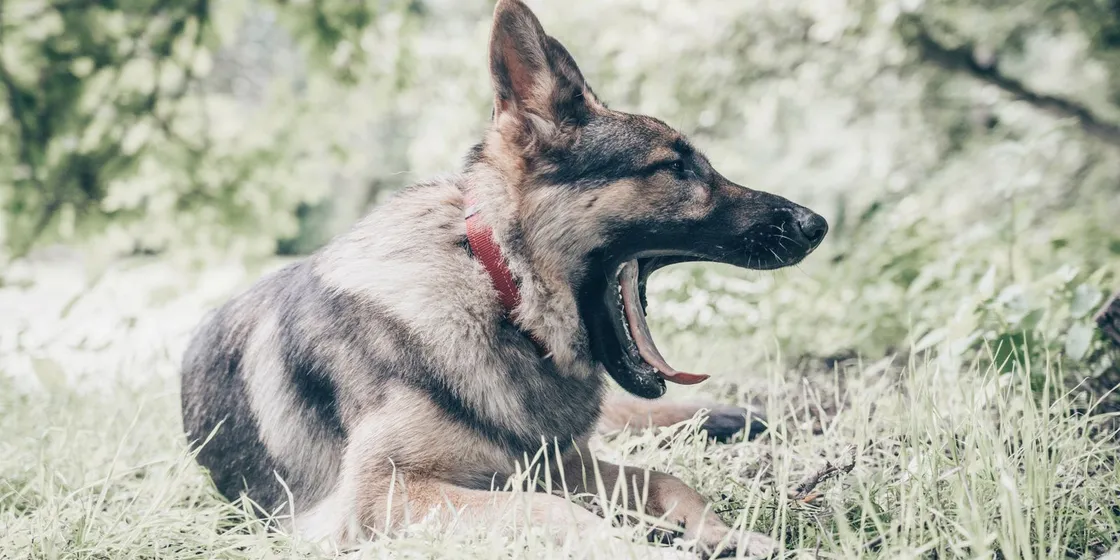
- yawning when not tired
- turning the head or the whole body away
- blinking, squinting or looking away
- sniffing the ground suddenly in the middle of an interaction
- moving slowly or lifting a front paw
- shaking off as if wet after a tense moment
- scratching without an itch
One signal alone means little. Several in a row, or one signal that appears every time a certain thing happens, tells you the dog is uncomfortable with that thing. This is especially useful with puppies during socialization and with newly adopted dogs, who often communicate quietly at first; see our guide to settling in a rescue dog.
Signal, likely meaning, what to do
| Signal | Likely meaning | What to do |
|---|---|---|
| Loose body, soft eyes, mid-height sweeping wag | Relaxed, sociable | Carry on; let the dog approach you |
| Lip licking, yawning, head turned away | Mild stress or uncertainty | Pause, stop touching, give more room |
| Whale eye, closed mouth, body going still | Clear discomfort, often when guarding or being held | Stop and move away calmly |
| Low body, tucked tail, ears flat | Fear | Add distance, do not reach over the dog, let them retreat |
| Tall and stiff, weight forward, high fast wag, hard stare | High arousal, possible threat | Do not approach; calmly increase distance |
| Freeze, lifted lip, growl | Final warning before a snap | End the interaction at once, no punishment, find the trigger |
| Play bow, bouncy movement, role reversals | Play invitation | Allow it; interrupt briefly if one dog stops enjoying it |
The escalation ladder
Dogs rarely bite “out of nowhere”. Most move through a sequence, and they climb it only when the lower steps did not work:
- blinking, yawning, lip licking
- turning the head, then the body, away
- walking away, or sitting and lifting a paw
- lowered body, ears back, tucked tail, or lying down with a leg lifted
- stiffening and staring
- growling
- snapping in the air
- biting
The speed varies. A confident dog in a tense moment can go from step 2 to step 6 in seconds, and a dog whose early signals have been ignored for months may start much higher up. That is why families are often surprised: the dog did warn, but quietly, and nobody answered. A dog that shows its belly while tense and still, with the tail tucked, is on step 4 and asking for space, not for a belly rub.
Why you should never punish a growl
A growl is the last clear, non-harmful message a dog has. Punishing it, whether by scolding, a leash jerk or pinning the dog down, does not make the dog more comfortable with whatever caused it. It teaches that warning is unsafe. The fear or irritation remains, the warning disappears, and the dog may skip straight to a snap next time.
Do this instead:
- Stop what you or others are doing and create distance without fuss.
- Note the context: what was the dog doing, what approached, what was touched or taken?
- Manage the situation so it does not repeat: feed the dog undisturbed, give a safe resting place, supervise children.
- Change the association with reward-based training, ideally with guidance.
The idea that a growling dog is trying to dominate you is outdated. Growling over food, resting places or handling is about discomfort or fear of losing something, and it responds to management and positive reinforcement, not to confrontation.
Common mistakes
- Treating a wag as an invitation. Check height, stiffness and the rest of the body first.
- Reading a “guilty look” as guilt. Lowered head, averted eyes and flattened ears after you find a chewed shoe are appeasement in response to your tone, not an admission.
- Overlooking stillness. A dog that stops moving under a child’s hand is not being patient. Stillness is a warning.
- Hugging and leaning over. Many dogs tolerate it; few enjoy it. Use the three-second rule: stroke, pause, and continue only if the dog asks for more.
- Letting dogs “sort it out”. If one dog keeps signaling to be left alone and the other ignores it, step in.
- Judging by one body part. Raised hackles, for example, show arousal and occur in play as well as in conflict.
Reading these signals is also the basis for working with a dog that barks and lunges on walks, covered in our guide to leash reactivity, and for telling normal mouthing from real warning in puppy biting.
When to get professional help
See your vet promptly if a dog’s behavior changes suddenly, for example a previously tolerant dog starts growling when touched, flinching, or avoiding contact. Pain is a common cause. Contact a qualified behavior professional who works with reward-based methods if your dog growls or snaps regularly, guards food or places, freezes around children, or has bitten. Until then, manage the environment so the dog is not put in the situation again.
Frequently asked questions
Does a wagging tail always mean a dog is happy?
No. A wag signals arousal and a willingness to interact, which can be friendly or not. A loose, sweeping wag at mid height that moves the hips is typical of a relaxed, sociable dog. A tail held high and stiff, wagging in short fast beats, is a warning. A low, quick wag with a crouched body usually signals insecurity.
What is whale eye in dogs?
Whale eye is the white crescent that shows when a dog turns the head away but keeps the eyes on something that worries them. It often appears when a dog is hugged, cornered or guarding food or a toy. Together with a stiff body and closed mouth it is a clear request for space. Stop what you are doing and move away.
Why does my dog yawn or lick their lips when I hug them?
Most dogs tolerate hugs rather than enjoy them, because being held around the neck or body restricts movement. Yawning, quick lip licks and turning the head away in that moment are signs of mild stress. Try stroking the chest or shoulder for three seconds instead, then pause and see whether your dog leans in for more.
Should I tell my dog off for growling?
No. A growl is information: your dog is uncomfortable and asking for distance. If growling is punished, many dogs learn to stop growling while the discomfort stays, and the next step may be a snap without warning. Calmly end the situation, give the dog space and work out what triggered it. Frequent growling warrants professional advice.
How can I tell play from a real fight?
Play is loose and bouncy, with play bows, exaggerated movements, role reversals and frequent short pauses. Both dogs return for more after a break. Warning signs are stiff bodies, one dog repeatedly trying to leave, pinning without release, a hard stare or rising pitch. If in doubt, calmly call the dogs apart and see whether both want to continue.
Do short-nosed or docked breeds signal differently?
The signals are the same, but some are harder to see. Flat-faced breeds have less mobile facial features, heavy coats hide raised hackles and eyes, and a docked or tightly curled tail conveys less. With these dogs, pay more attention to overall posture, weight shift, muscle tension and movement, and give other dogs extra time to read them.
Sudden changes in behavior, signs of pain or any aggression should be checked by a veterinarian or a qualified behavior professional before you start training.