Loose Leash Walking: How to Teach Your Dog Not to Pull
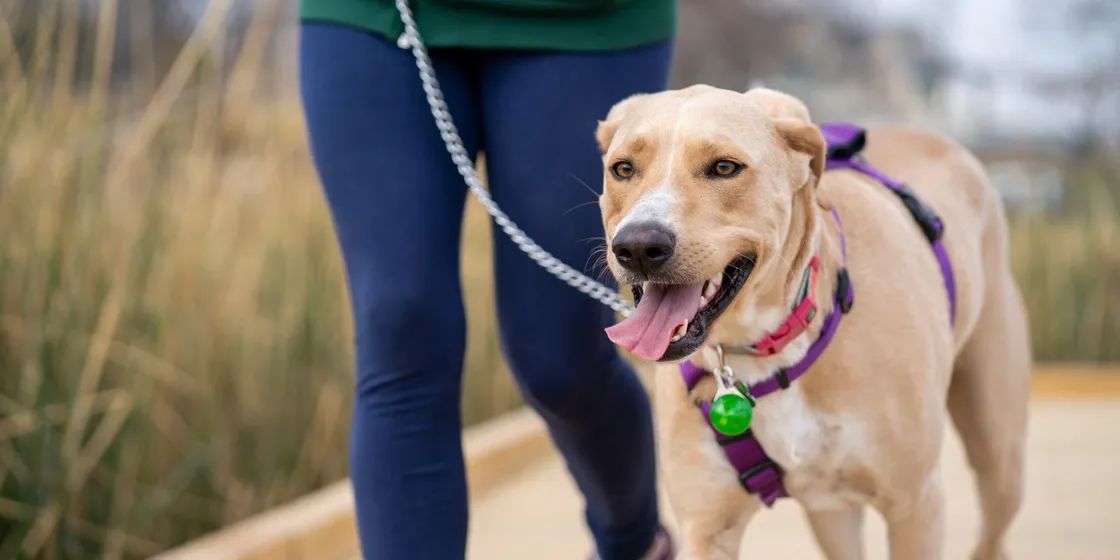
Key takeaways
- Dogs pull because pulling gets them where they want to go, not because they are stubborn or trying to lead.
- A well-fitted harness and a 2–3 m (6–10 ft) leash make training easier and keep pressure off the neck.
- Reward generously next to your leg so that the spot beside you becomes the most rewarding place on the walk.
- When the leash goes tight, stop or change direction calmly; forward movement only happens on a slack leash.
- Start in a boring place and add distractions in small steps, expecting several weeks to months of practice.
Loose leash walking means the leash hangs in a relaxed curve while your dog moves with you, wherever exactly they are walking. You teach it by rewarding your dog for being near you and by making sure a tight leash never moves them forward. With short daily sessions, most dogs improve noticeably in quiet places within a few weeks; busy environments take longer.
Why dogs pull on the leash
Pulling is not a sign of dominance or stubbornness. It has simple causes:
- Dogs are faster than people. A relaxed trot for most dogs is quicker than a human walking pace. Slowing down to our speed is a skill, not a default.
- Pulling works. Every time a tight leash is followed by reaching the lamp post, the other dog, or the park, pulling is reinforced. Dogs repeat what pays off.
- The outside world is exciting. Smells, movement, and sounds compete with you for attention, and nobody has yet taught the dog what to do instead.
- Pressure becomes normal. A dog that has pulled for months no longer notices leash tension as information.
The solution follows from the causes: make walking near you worthwhile, and stop a tight leash from paying off. This is positive reinforcement on walks.
Equipment that helps, and what to avoid
Equipment does not train a dog, but it can make training easier or harder.
- Harness: Choose a well-fitted, Y-shaped harness that leaves the shoulder joints free and does not rub behind the front legs. You should be able to slide two fingers under every strap. A model with both a front (chest) clip and a back clip is useful: the front clip reduces leverage when the dog pulls, the back clip suits relaxed sniffing walks.
- Leash: A 2–3 m (6–10 ft) leash gives the dog room to sniff without constant tension. Very short leashes make a slack leash almost impossible. Retractable leashes keep constant tension on the dog and therefore teach the opposite of what you want.
- Rewards: Small, soft treats your dog really likes, in a pouch on the side where the dog will walk.
Avoid choke chains, prong collars, slip leads used as corrections, and leash jerks. They work through pain or discomfort, can injure the neck, and are associated with more stress and fear in dogs. The AVSAB position statement on humane dog training (2021) recommends reward-based methods for all training, including leash manners.
The reward position
Decide on which side your dog should walk and stick with it during training. The reward position is the spot where treats appear: at your leg, at the height of the dog’s nose, on that side.
Two details matter:
- Feed where you want the dog to be. If you hand the treat out in front of you, the dog learns to swing in front. Deliver it at the seam of your trousers.
- Mark first, then reach. Use a marker word such as “yes” or a click the moment the leash is slack and the dog is beside you, then bring the treat to your leg. If you are new to markers, the guide to clicker training explains the timing.
Step by step: teaching a loose leash
Practice in 3–5 minute sessions, two or three times a day, before the dog is tired or overexcited.
- Charge the position indoors. In a quiet room, without a leash, stand still. Whenever the dog stands next to your leg, mark and feed at your leg. Repeat 10–15 times until the dog chooses that spot quickly.
- Add one step. Take a single step, mark as the dog moves with you, feed at your leg. Do 10 repetitions, then try two steps, then three.
- Clip on the leash. Repeat the same exercise with the leash attached, still indoors or in the garden. Hold the leash hand against your body so its length stays constant.
- Reward densely at first. In a new place, reward every two or three steps. A high rate of reward at the start is what builds the habit.
- Stretch the distance. When the dog stays beside you for five steps with a slack leash on most attempts, vary the count: reward after three steps, then seven, then four, then ten. Keeping it unpredictable holds attention.
- Add a release to sniff. After a stretch of good walking, say “go sniff” and let the dog explore on the full leash length. Access to smells is a powerful reward and reduces how much food you need.
- Move outdoors. Start on a quiet street or empty car park and return to step 4 for the first sessions there.
A useful rule of thumb: if your dog succeeds on about eight out of ten attempts, make the exercise slightly harder. If they manage fewer than six, make it easier.
When the leash goes tight: stop-and-go and direction changes
Even with good training, the leash will go tight sometimes. What you do next decides whether pulling keeps paying off.
Stop-and-go. The moment the leash tightens, stand still. Say nothing and do not pull back. Wait until the dog loosens the leash by stepping back, turning, or looking at you. Mark, reward at your leg, and continue. Forward movement itself becomes a reward for slack.
Direction changes. Some dogs simply lean into the harness and wait when you stop. For them, turn calmly and walk the other way before the leash is fully tight, announcing it with a friendly cue such as “this way”. Reward when the dog catches up at your side. The turn is information, never a jerk: give the dog time to notice and follow.
Circle and reset. If the dog is fixed on something ahead, walk a small arc away, reward a few steps of slack leash, and approach again. Reaching the interesting thing on a loose leash is the best reward you can offer.
Raising the difficulty gradually
Most frustration comes from asking for too much too soon. Raise only one factor at a time.
| Stage | Environment | Goal before moving on |
|---|---|---|
| 1 | Living room, hallway | 20 steps, reward every 5–10 steps |
| 2 | Garden, quiet driveway | 30 steps with one “go sniff” break |
| 3 | Quiet residential street | 5 minutes with rewards every 10–15 steps |
| 4 | Park at a quiet time | Passing people at 10 m (33 ft) on a slack leash |
| 5 | Busy path, other dogs in view | Short stretches, high rate of reward again |
Whenever you move to a new stage, go back to frequent rewards. Distance is your main tool: if the dog cannot respond, you are too close to whatever is exciting them. Learning to read early signs of arousal in your dog’s body language helps you turn away in time.
Training walks and everyday walks
Nobody can train perfectly on every outing. A practical solution is two clearly different setups:
- Training mode: leash on the front clip, treats ready, the loose-leash rule applies without exception. Keep it to 5–10 minutes.
- Free mode: leash or long line on the back clip, the dog may sniff and roam within the line, and you manage rather than train.
The dog learns to tell the two situations apart, and pulling is not rehearsed on the training setup. As skills improve, training mode takes up more of the walk.
Common mistakes
- Starting on the usual walk. The regular route is full of established pulling. Begin indoors.
- Rewarding too rarely. One treat every hundred meters cannot compete with the environment early on.
- Feeding in front of the body. This pulls the dog out of position.
- Inconsistency. If pulling works on Tuesday because you are in a hurry, it will be tried again on Wednesday.
- Walking an overexcited dog straight into training. A few minutes of sniffing, a short game, or a calm start in the garden first makes focus possible.
- Jerking the leash. It adds discomfort without teaching the dog what to do, and it can damage trust.
When professional help makes sense
Ordinary pulling responds to the steps above. Get support from a qualified, reward-based trainer or behavior consultant if your dog lunges, barks, or growls at other dogs or people, which points to leash reactivity rather than a simple pulling problem. The same applies if the dog is so strong that walks are unsafe for you. If a dog that used to walk well suddenly pulls, lags, coughs on the leash, or resists the harness, see a vet first to rule out pain.
Loose leash walking combines well with a solid recall and a few basic commands: together they give your dog more freedom and make walks calmer for both of you.
Frequently asked questions
How long does it take to teach a dog to walk on a loose leash?
It depends on the dog's age, how long pulling has already worked, and how consistent everyone in the household is. Many dogs walk nicely in quiet places after two to four weeks of short daily sessions. Reliable behavior around other dogs, wildlife scents, or busy streets usually takes several months. Setbacks during adolescence are normal and do not mean the training has failed.
Is a harness or a collar better for a dog that pulls?
A well-fitted harness is the safer choice for a pulling dog because it spreads pressure across the chest instead of the throat. A front clip can reduce the force of pulling by turning the dog slightly sideways. Neither tool teaches loose leash walking on its own, though. The dog learns the skill through rewards, and the harness simply keeps practice comfortable and safe.
Why does my dog pull more on the way out than on the way home?
At the start of a walk the dog is rested, full of energy, and surrounded by fresh smells, so motivation to move forward is at its highest. On the way home some of that energy is gone and the route is already explored. It helps to begin with a few minutes of sniffing or play in a quiet spot before asking for focused walking.
Should I stop every single time the leash goes tight?
During training sessions, yes: consistency is what makes the rule clear. If pulling works sometimes, the dog learns to keep trying. Because that level of consistency is hard on every outing, use two setups. On the training setup the rule always applies. On a different setup, such as a back clip and a longer line, you manage the walk without practicing.
Can an older dog still learn not to pull?
Yes. Adult and senior dogs learn by the same principles as puppies. They often have years of practice at pulling, so progress can be slower at first and old habits return quickly in exciting places. Short sessions, high-value rewards, and a gradual increase in difficulty work at any age. If an older dog suddenly starts pulling or lagging, have a vet check for pain.